Fault Current Limiting/Interrupting Solutions
Utility network operators are investing hundreds of millions of dollars in upgrading and replacing existing equipment. They often have no choice other than segmenting the grid which negatively impacts the quality and availability of their network. Independent power producers are required to make significant investments and bear long delays, before receiving permits to connect distributed generation and renewable sources.
GridON is offering grid operators, Independent Power Producers (IPP) and industrial customers cost-effective fault current limiting/interrupting solutions, which enable increased power capacity in meshed networks, and cost-effective connection of utility-scale and Distributed Generation (DG) and renewable energy sources - while improving power quality and network stability.
GridON offers solutions for all power and voltage levels: a power-electronics Fault Current Limiting Interrupter (FCLi) for low-to-medium voltage connection of distributed generation and renewable sources; and a saturated core Fault Current Limiter (FCL) for medium-to-high voltage distribution and transmission networks. GridON's FCL/FCLi limit and interrupt fault currents from propagating through the network, thus preventing power failures and network outages. These cost-effective solutions significantly reduce capital expenditure and time consuming labor, required for conventional network upgrades.
Power-electronics Fault Current Limiting Interrupter (FCLi)
The FCLi is a series-connected solid-state based device which interrupts network current and limits transient voltages to acceptable levels, instantly upon detection of short circuit conditions. The FCLi is using a proprietary detection algorithm to sense faults. It then limits and interrupts excessive fault infeed from the generator to the grid within few milliseconds, well before the first current peak (typically, within 0.5 millisecond). The FCLi also protects private generators from fault currents which flow in their direction. Once the short-circuit condition is cleared, the FCLi immediately resumes normal conducting state. The use of power electronics enables fast recovery and immediate return to service after each interruption operation, without replacing any parts and without coming to site.
The FCLi was successfully tested at KEMA Labs, where it was subjected to multiple prospective fault currents – phase-to-earth, phase-to-phase and three-phase up to 25kA RMS, and fully interrupted the currents well before the first peak. The FCLi has undergone extensive factory acceptance tests such as functional tests, temperature rise tests and dielectric tests including lightning impulse test at 95kV.
 |
Using FCLi to connect a 12MVA generator at 11kV
|
Power-electronics Fault Current Limiter Diverter (FCLd)
The FCLd (in development) is a power-electronics based solution which enables the connection of new power stations to transmission networks. It mitigates rising fault currents from connection of utility-scale and distributed generation as well as from increasing transformers capacity in distribution substations. The FCLd can be used with generators operating at all common voltage levels and power levels, as well as in medium voltage substations. The FCLd provides solutions for both distribution and transmission networks.
Upon detection of short-circuit conditions, the solid-state devices create a diverting path for a portion of the current, limiting the fault contribution to be within equipment ratings. The diverting current path of the FCLd is connected in parallel with the generator or transformer's main path. The FCLd's proprietary fault detection mechanism is configurable and flexible, allowing selectivity of the protection equipment.
The FCLd is a perfect solution for high voltage and power ratings, enabling immediate recovery when the fault condition is cleared. It is easy to operate, requiring no part replacement or-site presence.
1) Enabling connection of generation or synchronous compensators to transmission grids:
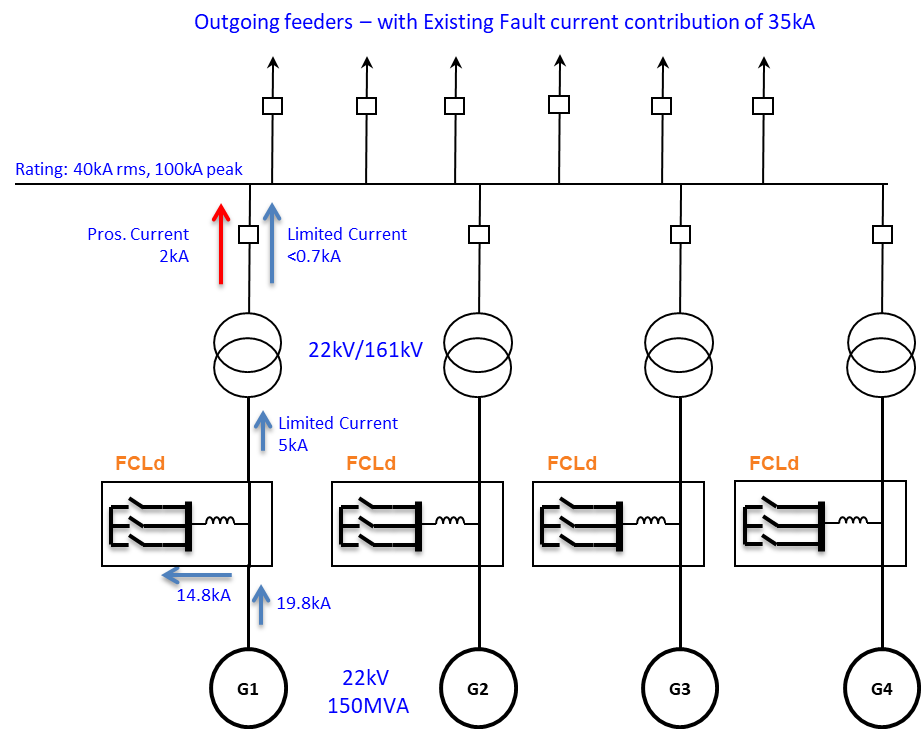
Using FCLd devices to limit fault current contribution into a fault constrained 161kV network (with 35kA existing fault level). Adding 4 new generators – raises fault level to 43kA – above the allowed 40kA. An FCLd added to each generator reduces fault current to less than 38kA on 161kV bus. Higher power generators (hundreds of MVAs) can be accommodated by using parallel FCLd devices. Such parallel arrangement allows for flexible and remotely managed limitation of fault current.
 |
2) Enabling increased power supply in a distribution substation:
By mitigating the fault current contribution from one or more transformers in the substation, the utility can connect multiple transformers and approve connection of additional private generation capacity, while ensuring that prospective fault current will always be kept within equipment limits. Without the FCLd, the fault level exceeds the equipment ratings when the bus-tie circuit breaker is closed, and/or when the private generation is in operation. With the FCLd in operation, it will limit the fault current contribution from the transformer to the downstream equipment, allowing safe operation within the equipment ratings.
3) Enabling connection of generator sets into high voltage networks:
A single FCLd protects the 33kV network from fault current contribution from 6 LV generators. Without FCLd, the connection of the generator sets will drive the fault current beyond the 33kV substation equipment ratings. With an FCLd, the fault current contribution from the generator sets is reduced, allowing the 33kV substation to operate within its equipment ratings.
Saturated-core Fault Current Limiter (FCL)
The FCL is a passive, self-triggered system – presenting high impedance during fault condition and low impedance in normal operation. The FCL combines proprietary concept of electromagnetic flux alteration on a saturated core with conventional power transformer technology. The proprietary concept utilizes the non-linear magnetic characteristic of iron core to introduce very high impedance to the grid during fault conditions. The unique geometry of the FCL enables significant increase of impedance during fault, providing ample current limiting.
The FCL’s variable-impedance system responds instantaneously to current spikes long before the first peak, suppresses fault current for its entire duration, and recovers immediately following fault clearance – being always ready for consecutive faults.
 |
Using FCL to enable connection of 4 parallel transformers
|
Being scalable to very high voltage and power ratings, this commercially available, fail-safe product is well-suited for transmission and distribution network applications. The “transformer-like” FCL systems are very robust and easy to install and maintain.
The FCL was adopted as a commercial, business-as-usual solution by a number of network operators, including UK Power Networks and National Grid Electricity Distribution, proving reliable and effective in limiting numerous fault current events.
Typical applications
 |
 |
 |
FCLi enables cost-effective connection of distributed generators and low carbon energy sources from IPPs and industrial/commercial generators into low-medium voltage networks. It enables sale of excess generation capacity to the grid.
|
FCL/FCLi on a transformer feeder enables paralleling of multiple transformers on a single connected bus, reducing the overall substation fault levels to be within switchgear ratings.
|
FCL/FCLi in a bus-tie location enables paralleling bus sections during loss of power sources, improving network interconnectivity and power quality.
|
Please complete the request form in order to learn more about our FCL/FCLi solutions and their capabilities.